Most damp reports on Darlington rental property are not roof failures — but establishing which ones are, and evidencing it, is now a compliance exercise as much as a maintenance one.
Tell us the job in 30 seconds. No pushy sales, no call-out fee.
3
Distinct Causes
£180
Investigation From
48hr
Written Report
0
Lifestyle Assumptions
Roof-sourced damp in Darlington rentals is usually a blocked gutter or valley, a failed chimney flashing, or a back-addition valley on a Victorian terrace. Condensation from missing eaves ventilation is more common still. Investigation with a written report costs £180 to £350. Call 01325 787169.
Diagnosis
Is It Water Coming In, or Water Already Inside?
Every damp report in a rented property is one of three things, and the remedy is completely different for each. Getting this wrong is expensive in both directions — replacing a sound roof that was never the problem, or dismissing a genuine defect as tenant behaviour.
Penetrating damp: water entering through the building fabric. Localised, defined edge, often a tide mark, worsens during and immediately after rain. Roof, gutter, flashing or wall.
Condensation: moisture already in the air meeting a cold surface. Diffuse, worst in winter, concentrated in corners, on cold external walls and behind furniture. Usually presents as black spot mould rather than staining.
Rising damp: genuinely uncommon, and frequently misdiagnosed. Confined to the base of walls with a defined horizontal tide mark, typically under a metre.
When the roof is not the answer: if the mould is in bathroom and bedroom corners, on external wall faces, worse in winter, and there is no staining or tide mark, a roof repair will not fix it and quoting for one is either careless or dishonest. What that property needs is a ventilation assessment — which is still a building defect and still your responsibility.
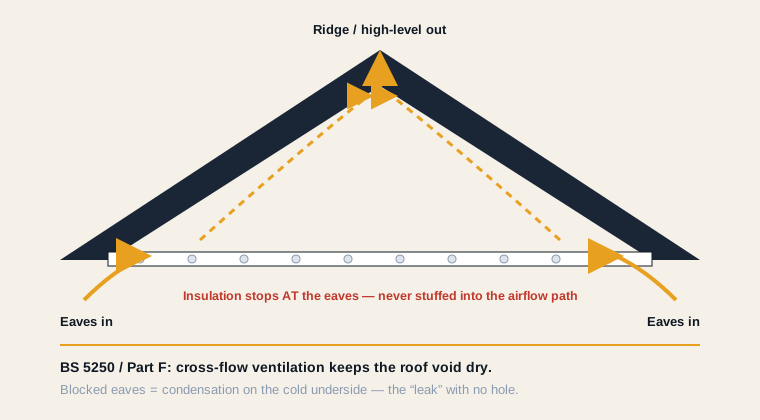
Roof void airflow: insulation must stop at the eaves or the ventilation path closes.Local knowledge
The Four Causes We Actually Find in Darlington
1. The back-addition valley on Victorian terraces. The railway terraces through Albert Hill, Eastbourne, North Road, Rise Carr and Bank Top were built with a rear projecting wing, creating an internal valley gutter between the main roof and the addition. Narrow, often lead-lined, and the first thing to collect debris. When it blocks, water does not run harmlessly down an outside wall — it backs up under the slates and comes through into the bedroom below, presenting exactly like roof failure. This is the single most common genuine roof cause in Darlington’s rental stock, and it is prevented by annual clearance costing under £150.
2. Gutter overflow onto solid brickwork. Those same terraces have no cavity. Water overflowing at the eaves saturates the wall face, and once the brickwork is regularly wet you get penetrating damp straight through at first-floor level, perished plaster and efflorescence salts. Darlington’s frost cycling makes it worse: saturated brick that freezes hard spalls at the face, and once the face has gone the wall absorbs faster every year.
3. Failed chimney flashing. A damp chimney breast is very often a split or lifted lead apron rather than the stack pointing above it. On interwar and post-war stock with abandoned flues the problem compounds, because an unused flue never dries out and the salts in old soot deposits pull moisture through into the plaster.
4. Missing eaves ventilation — the biggest of all. Much of the pre-1980 stock across Firthmoor, Skerne Park, Branksome, Red Hall and Haughton was built with no eaves ventilation whatsoever. Add modern insulation depths and you have a cold roof void with warm moist air entering from below and nowhere to go. The result is condensation on the underside of the covering, dripping onto the insulation, and staining that looks exactly like a leak. There is no hole anywhere in the roof.
The process
What to Expect: a damp investigation in Darlington
1. Take the report seriously and date it
Record what was reported and when. Ask the tenant for photographs if they can take them safely.
2. Establish the pattern before attending
Does it worsen with rain, or with cold weather? Which rooms, which walls, staining or black spot? This narrows the cause before anyone arrives.
3. External inspection
Roof covering, flashings, valleys, gutters and downpipes, and the wall faces beneath them. Photographed.
4. Internal and loft inspection
The affected area, and the roof void above it — ventilation paths, insulation position at the eaves, condensation evidence on the membrane underside.
5. Moisture assessment
Readings taken where they help distinguish penetrating damp from condensation, and where a pattern needs evidencing.
6. Written report identifying the cause
With photographs, delivered within 48 hours, stating what the cause is and what would remedy it — including where the answer is ventilation rather than roofing.
7. Remedy and confirm
Works carried out, then written confirmation to you and the tenant that the cause has been addressed.
The drying period is worth setting out to the tenant in writing. A wall that has been saturated for a winter does not dry in a fortnight, and tenants reasonably assume nothing has been fixed if nobody tells them that.
Access
Scaffold, Skips & Street Access
A damp investigation needs internal access as well as external, which means coordinating with the tenant rather than just turning up. Scaffold is specified for: flashing renewal, valley re-lining and any remedial work at height beyond gutter clearance - always itemised in your written quote, never a hidden extra, and we arrange it.
Darlington splits into two access worlds: the railway terraces at Albert Hill, Eastbourne and North Road, where there is no rear vehicle access and scaffold is hand-carried through the house or licensed onto the pavement, and the open post-war estates at Firthmoor, Skerne Park and Whinfield where a wagon can park on the drive. Pavement scaffold and skip permits go through Darlington Borough Council; allow a few working days on streets like Skinnergate, Post House Wynd, Bondgate, Clark’s Yard where space is tight.
The numbers
What Each Cause Costs to Fix
Cause
Remedy cost
Notes
Blocked gutters or downpipes
£80–£150
Most common, cheapest to prevent
Blocked back-addition valley
£120–£300
Clearance; re-lining costs more
Valley re-lining
£400–£1,200
Where lead has failed
Chimney flashing renewal
£350–£700
Scaffold usually needed
Eaves ventilation installation
£350–£900
Fixes condensation properly
Damp investigation and report
£180–£350
Credited against work booked
What moves the price
Whether the cause is drainage, covering, flashing or ventilation — a tenfold cost range
Access, particularly on terraces with no rear entry
Whether internal making-good is needed once the cause is fixed
How long the defect has run, since prolonged saturation damages plaster and timber
Whether the same property has recurring reports, which points to a systemic rather than a one-off issue
Worked example: a two-bedroom terrace at Albert Hill with black mould in the rear bedroom and a stain on the ceiling. Investigation found the back-addition valley packed solid and the loft with insulation stuffed hard into the eaves. Valley cleared, eaves trays fitted and over-fascia vents installed: £760 total. The tenant’s report had been open for three months before we were called, and the plaster needed replacing — which it would not have done at week one.
Standard trade pricing with no landlord premium. Written reports and photographs included on every job.
Covering DL1, DL2, DL3 and surrounding postcodes.
Guarantee
Your Guarantee, Explained
Remedial work carries the standard written 10-year workmanship guarantee. The investigation report is a separate deliverable and it is yours regardless of whether you use us for the works — which matters, because its value to you is evidential.
Covered: workmanship for 10 years, in writing, transferable if you sell.
On top: manufacturer warranties on materials (terms vary by product).
Not covered: storm or impact damage - that is an insurance matter, and we will document it for your claim.
If a fault appears in covered work, we come back and put it right. No quibbling, no re-charge.
The Housing Health and Safety Rating System treats damp and mould growth as a hazard category, and a serious case can be assessed as Category 1, which places a duty on the local authority to take enforcement action. Guidance issued for the social housing sector is explicit that landlords should not attribute damp and mould to tenant lifestyle without properly investigating the condition of the building — a position courts have applied similarly in fitness for habitation claims.
Source: Housing Health and Safety Rating System (Housing Act 2004) and MHCLG damp and mould guidance
Tenant Reported Damp or Mould?
Investigation with a written report inside 48 hours — and an honest answer, including when the cause is not the roof.
The repair is usually the cheap part. What decides a disrepair claim is whether you can show what you did, when, and on what basis.
A dated written report identifying the cause — even where the cause turns out to be ventilation rather than the roof, and even where the remedy is modest — demonstrates that you investigated the building rather than dismissing the tenant. That is the specific failure that judgments and ombudsman decisions criticise, and it is entirely avoidable for a few hundred pounds.
It also protects you the other way. Where an investigation genuinely establishes that a tenant’s drying of laundry indoors with no extract running is contributing, you have a documented finding made by a third party rather than an assertion. You still have to address the building side, but the record is balanced and contemporaneous.
“Investigated properly instead of just quoting for a roof. Turned out to be ventilation and a blocked valley. Report was clear enough that I could send it straight to the tenant.”
Rachael P. · Landlord, Eastbourne, Darlington
★★★★★
“Three months of back and forth with a tenant about mould. They came out, found the eaves packed with insulation, fixed it in a day. Should have called them at the start.”
Mohammed I. · Landlord, Skerne Park, Darlington
★★★★★
“The written report with the photographs is what I actually paid for. Repair was three hundred quid. The document was worth ten times that when it went to the council.”
Andrew S. · Landlord, Darlington
FAQ
Frequently Asked Questions
Roof-sourced damp is usually localised, has a defined edge, often a tide mark, and worsens during or straight after rain. Condensation is diffuse, appears on cold surfaces and in corners, is worst in winter and in rooms with moisture sources, and typically shows black spot mould rather than staining. The reliable test is timing: if it tracks rainfall it is water ingress, if it tracks cold weather and occupancy it is condensation.
No, and treating it that way is now a poor position to take. Government guidance for the social sector is explicit that damp and mould should not be attributed to lifestyle without investigating the building, and courts take a similar view in fitness claims. Inadequate ventilation is a building defect, and much of Darlington’s pre-1980 stock has no eaves ventilation at all.
In order of how often we find them locally: blocked gutters and valleys overflowing onto solid brickwork; failed chimney flashing soaking a chimney breast; back-addition valley gutters on Victorian terraces backing up under slates; slipped tiles or failed underlay letting water into the void; and blocked or absent eaves ventilation causing condensation on the underside of the covering.
Adding insulation without ventilation can, yes. Insulation keeps the roof void colder, so moist air rising from the dwelling condenses on the cold underside of the membrane or felt. If insulation has been stuffed into the eaves it also blocks the airflow path. This is one of the most common causes of "roof leaks" with no hole anywhere.
Investigate promptly and put your findings in writing. For private landlords there is no fixed statutory clock yet, but the social housing standard — investigate within a set period, written summary to the tenant, works begun promptly — is the benchmark a court is likely to regard as reasonable, and it is where the law is heading.
It manages the symptom, and it is a reasonable short-term step while a cause is being established. It is not a remedy and offering one instead of an investigation reads badly in a disrepair claim. If the underlying cause is a blocked gutter or a missing eaves vent, the dehumidifier is running to compensate for a defect.
External roof and drainage inspection, internal inspection of the affected area, loft inspection for ventilation and condensation evidence, moisture readings where useful, and assessment of extract ventilation in kitchens and bathrooms. You get a written report identifying the cause with photographs — which is the document that protects you whichever way the answer falls.
£180 to £350 for a damp and leak investigation with a written report across Darlington and County Durham. If remedial work follows and you book it with us, that fee is credited against the invoice. The report is yours either way.
Get In Touch
Get a Damp Investigation in Darlington
Roof, drainage and ventilation all assessed, written report with photographs inside 48 hours, and an honest answer even when it means telling you the roof is fine.