The most expensive decision in roofing, and the one most often made on somebody else’s say-so. Here is the framework we use — including the cases where replacement is genuinely oversell.
Tell us the job in 30 seconds. No pushy sales, no call-out fee.
30%
The Rule of Thumb
3
Questions to Answer
£120
Independent Check
Both
Ways, Honestly
Repair your roof if under about a third of the covering has failed, fixings are sound and the underlay is intact. Replace if tiles lift by hand across whole planes or the underlay has gone. Cost per remaining year of roof life is the honest test. Call 01325 787169.
The framework
Three Questions That Decide It
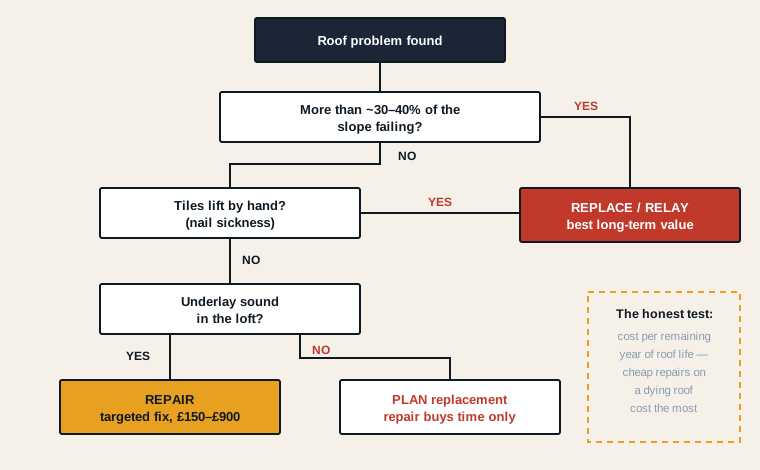
Almost every repair-or-replace decision comes down to three questions, answered in order. You cannot answer any of them from the pavement, which is why a quote given without anyone going onto the roof is worthless.
How much of the slope has failed? Under roughly 30 to 40 per cent, targeted repair is economic. Above it, you are paying access costs repeatedly on a covering that will keep failing somewhere else.
Do the tiles or slates lift by hand? If the fixings have corroded through across a plane, the covering will keep slipping regardless of how sound the material is. That is nail sickness, and it decides the job.
Is the underlay sound? A covering can be perfect over a failed underlay. That is a strip-and-relay, not a replacement — a very different price using your existing material.
When replacement is oversell: a handful of slipped tiles on a roof with sound fixings and intact underlay does not need replacing, whatever anybody has told you. Nor does a Victorian slate roof where only the nails have gone — that slate has another century in it and belongs back on the building. If a quote for a full re-roof arrives without photographs of lifted tiles showing the nail condition, ask for them before you sign anything.
Repair or replace: three questions decide it — extent, fixings, and underlay.Local knowledge
Age and Condition by Darlington Housing Era
Darlington’s three housing eras reach the end of their roof life in three different ways and on three different timetables. Knowing which one you own narrows the decision considerably before anyone climbs a ladder.
Pre-1919 railway terraces — Albert Hill, Eastbourne, North Road, Rise Carr, older Cockerton. Welsh slate on battens with lime torching, no membrane. The slate is typically fine at 130 years old; the nails and torching are not. The overwhelmingly common answer here is a strip-and-relay at roughly £180 to £240 per square metre, reusing 60 to 80 per cent of the original slate. A full re-slate in new material at £200 to £280 per square metre is the wrong answer on most of these roofs, and it puts perfectly good Welsh slate in a skip.
Interwar semis — Harrowgate Hill, Mowden, Hummersknott, Carmel Road. Clay or early concrete tile, frequently with no underlay or with brittle bitumen felt. The covering often has decades left while the underlay has none. This is the classic strip-and-relay case too, and the moment to add the eaves ventilation these roofs were never built with.
Post-war estates — Firthmoor, Skerne Park, Branksome, Red Hall, Haughton, Newton Aycliffe. Concrete interlocking tile from the 1950s to 70s with galvanised nails now sixty years old. Here the tile itself is often genuinely near the end of its service life as well as the fixings, so full replacement at £5,500 to £9,000 for a three-bed semi is frequently the correct call rather than oversell. The tell is whether tiles have started to spall and flake on the face, not just slip.
Modern estates — Whinfield, West Park, Great Burdon, Ingleby Barwick. Anything built since the 1980s should have decades left. Problems on this stock are almost always mortar-bedded ridge and verge failing at twenty to thirty years, which is a £900 to £1,800 dry-fix conversion, not a roof problem at all.
The process
What to Expect: the decision in Darlington
1. Get the roof properly inspected
Somebody has to lift tiles and look at nails, and go into the loft. Expect £120 to £250 for a written photographic report, credited against work if you proceed.
2. Establish the failure mechanism
Covering failure, fixing failure and underlay failure lead to three different jobs at three different prices. This is the step most often skipped.
3. Calculate cost per remaining year
Divide the repair cost by the honest remaining life. Compare it against replacement cost divided by 40 to 60 years. The answer is usually clearer than it felt.
4. Consider phasing by plane
Weather-facing planes fail first. Replacing one slope now and the other in eight years is often better value than either doing everything or patching indefinitely.
5. Get three written quotes for whichever it is
Once you know what the job actually is, quotes become comparable. Before you know, they are not.
Darlington sits in the Pennine rain shadow, so rainfall is below the UK average — but frost cycling is above it, and frost is what destroys mortar. Locally, bedding and pointing fail earlier than coverings do.
Access
Scaffold, Skips & Street Access
The inspection that answers this question needs someone on the roof lifting tiles — usually from a ladder or roof ladder, or by drone on steep or high roofs. Scaffold is specified for: the work that follows, if it is a re-roof; the decision itself rarely needs scaffold - always itemised in your written quote, never a hidden extra, and we arrange it.
Darlington splits into two access worlds: the railway terraces at Albert Hill, Eastbourne and North Road, where there is no rear vehicle access and scaffold is hand-carried through the house or licensed onto the pavement, and the open post-war estates at Firthmoor, Skerne Park and Whinfield where a wagon can park on the drive. Pavement scaffold and skip permits go through Darlington Borough Council; allow a few working days on streets like Skinnergate, Post House Wynd, Bondgate, Clark’s Yard where space is tight.
The numbers
Repair Versus Replace: Real Darlington Costs
Option
Typical cost
Buys you
Targeted repair, a few tiles
£150–£350
5–15 years if the roof is otherwise sound
Ridge and verge dry-fix conversion
£900–£1,800
30+ years, removes the failure mode
Single plane strip and relay
£2,500–£4,500
40–60 years on that slope
Strip and relay, reusing covering
£4,500–£7,500
40–100 years depending on material
Full re-roof, three-bed semi
£5,500–£9,000
40–60 years, new everything
Full re-roof, detached
£8,000–£15,000
40–60 years, new everything
What moves the decision
Cost per remaining year, not headline price — the only number that compares the options fairly
Whether you are staying: a strip-and-relay you will not see the end of is different from one you will
Access cost, which is paid again on every separate repair visit and only once on a re-roof
Whether building regulations upgrades — insulation and ventilation — are triggered, which they are above a quarter of the covering
Whether the covering is genuinely reusable, which is a survey finding rather than an opinion
Worked example: a Victorian terrace off North Road quoted £12,000 for a full re-slate. The survey found sound Welsh slate with corroded nails and failed torching. Strip and relay reusing 70 per cent of the original slate, new membrane, battens and eaves ventilation: £16,800 all in for a larger roof than first assumed — but a full re-slate in new material would have been £20,500 and would have skipped a century of serviceable slate.
No deposit on repairs under £500. Staged payments on re-roofs with nothing payable before materials are on site.
Covering DL1, DL2, DL3 and surrounding postcodes.
Guarantee
Your Guarantee, Explained
Whichever route you take, our workmanship is guaranteed for 10 years in writing. Worth knowing when comparing options: a repair carries the same guarantee standard as a re-roof — the guarantee covers what we did, not how long the rest of your roof has left.
Covered: workmanship for 10 years, in writing, transferable if you sell.
On top: manufacturer warranties on materials (terms vary by product).
Not covered: storm or impact damage - that is an insurance matter, and we will document it for your claim.
If a fault appears in covered work, we come back and put it right. No quibbling, no re-charge.
RICS guidance on building condition is consistent that remaining service life, not age alone, should drive replacement decisions, and that elements should be assessed individually rather than a building being condemned wholesale. In roofing terms that means the covering, the fixings, the underlay and the structure each carry their own remaining life — and it is entirely normal for one to be finished while the others have decades left.
Source: RICS Home Survey Standard and BRE housing stock condition guidance
Not Sure Which You Need?
An independent inspection with photographs from the roof itself — £120 to £250, credited against any work you book.
If you have a quote for a re-roof and it does not sit right, an independent inspection is a sensible hundred and fifty pounds against a five-figure decision. Bring the other quote with you — a second opinion is far more useful when the person inspecting can address what has actually been claimed.
It goes both ways. We regularly confirm that a re-roof quote is fair and sensibly priced, and we say so. We also regularly find that a £8,000 quote describes a £600 ridge job. Neither outcome is predictable before somebody looks properly, which is rather the point.
If you would rather not involve a contractor at all, a chartered building surveyor will give you the same independence at a somewhat higher fee. Either way, insist on photographs taken from the roof — they are the difference between a diagnosis and an assertion.
Customer Reviews
Darlington Homeowners Who Asked the Question
★★★★★
“Told a full new roof was needed at twelve grand. These lifted a dozen slates, showed me the nails had rotted and the slate was fine, and relaid the lot with the original slate. Cheaper and it looks right on the street.”
Colin B. · North Road, Darlington
★★★★★
“They confirmed the other quote was fair and told me to go ahead with it. Did not try to win the job. That is why I rang them for the guttering six months later.”
Fiona M. · Mowden, Darlington
★★★★★
“Concrete tiles on a 1960s semi, faces flaking as well as slipping. They said replace and explained exactly why this one genuinely was the real thing. No pressure, and the reasoning made sense.”
Peter W. · Firthmoor, Darlington
FAQ
Frequently Asked Questions
Repair if less than about a third of the covering has failed, the fixings are sound and the underlay is intact. Replace if tiles or slates lift by hand across whole planes, the underlay has gone, or repair spend over the last five years is approaching a third of replacement cost. Anything else is a judgement call, and it should be made with photographs from the roof rather than from the pavement.
A rule of thumb rather than a law: once roughly 30 to 40 per cent of a slope has failed, spot repairs stop being economic because you are paying access costs repeatedly on a covering that will keep failing elsewhere. It is a starting point for the conversation, not a substitute for checking the fixings.
Concrete interlocking tile: 40 to 60 years for the tile, but the nails often fail first at 50 to 60. Welsh slate: well over a century for the slate, with the fixings failing at 80 to 100. Clay plain tile: 60 to 100 years. Flat roofs: felt 15 to 20, EPDM and GRP 25 to 30. Darlington’s frost cycling is harder on mortar than on coverings.
Sometimes, and sometimes emphatically not. The honest measure is cost per remaining year of roof life. A £300 repair on a roof with fifteen years left costs £20 a year. The same repair on a roof with two years left costs £150 a year, and you will be paying it again next winter. That calculation, not the headline price, is what should decide it.
Yes, and it is often the right answer. Aspect and exposure mean the north-facing and weather-facing planes routinely fail a decade before the others. Replacing a single plane is entirely legitimate, though matching becomes a consideration on a visible elevation, and on a terrace the street continuity matters.
It rarely adds its full cost in value, but a failing roof reliably subtracts more than the cost of fixing it — because buyers and surveyors price uncertainty pessimistically. If you are selling, a specialist condition report is often better value than a re-roof: it converts an open-ended risk into a known number.
Nail sickness is corrosion of the original ferrous fixings while the tiles or slates themselves remain sound. It does mean the covering will keep slipping, so it cannot be ignored — but on a slate roof it usually means a strip-and-relay reusing your existing slate, not a full replacement in new material. Getting this distinction right is worth thousands.
Yes, and it happens regularly. Our condition reports grade every finding as urgent, needed within twelve months, or monitor only, and plenty of Darlington roofs come back with nothing in the first two categories. A survey that only ever finds expensive problems is a sales tool.
Get In Touch
Get an Honest Answer About Your Darlington Roof
Independent inspection with photographs from the roof itself, graded urgent, twelve months, or monitor only. Fee credited against any work you book — and we will tell you when the answer is to do nothing.