A chimney stack is the most exposed masonry on your house — weather on all four faces, no shelter, and freeze-thaw cycling all winter. We repoint stacks using a mortar matched to the original brick, renew flaunching, and fit cowls or caps where a flue is no longer in use.
Tell us the job in 30 seconds. No pushy sales, no call-out fee. See how we work.
Chimney repointing in Darlington costs £150 to £800 per stack depending on size, access and how much mortar has been lost. Flaunching renewal runs £150 to £350, cowls £80 to £200 and full capping of a redundant stack £250 to £600. Call 01325 787169.
Repointing is one part of it. A stack that has lost its mortar has usually lost its flaunching and its flashing too, and doing one without the others means going back up within a couple of years.
Failed joints raked out and repointed in a mortar matched to the original. On Darlington's Victorian stock that means a lime-based mix — pointing soft handmade brick with a hard modern cement mix is the single most damaging thing done to historic chimneys.
Get a quote →The mortar fillet sealing the pots into the stack head cracks and lifts long before the pointing does. Once water gets past it, the stack saturates from the top down and no amount of repointing on the faces will keep it dry.
Get a quote →Rain caps, anti-downdraught cowls and bird guards. Jackdaws nesting in open Darlington flues are a genuinely common cause of blocked chimneys and internal staining, and a guard costs a fraction of a nest removal.
Get a quote →Where a flue is no longer used, the stack can be capped — but it must be vented top and bottom or the flue traps moisture and pushes damp into the chimney breast. Sealing a stack solid is a frequent and expensive mistake.
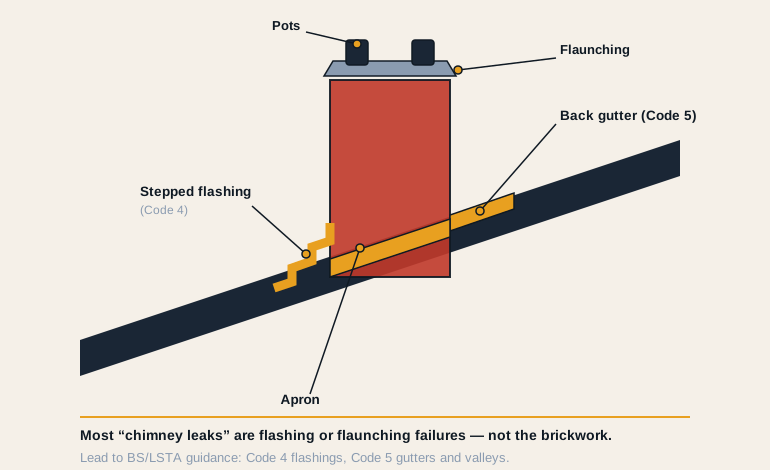
Get a quote →The apron, step and cover flashings where the stack meets the roof. Failed lead here soaks the stack from below and is often the actual cause of a damp chimney breast that has been blamed on the pointing.
Get a quote →Where frost has spalled the brick faces beyond saving, the stack is taken down to below the damaged courses and rebuilt in matching brick. On a terrace this often needs to be coordinated with the neighbour, and we handle that conversation.
Get a quote →Repointing is right when the joints have eroded but the brick faces are still sound. Once the faces have spalled and crumbled back, pointing over them buys a season and nothing more.
When it is not the answer: If the brick faces themselves have blown, repointing is the wrong job — the damaged courses need taking down and rebuilding, and anyone offering to point over spalled brick is selling you a temporary fix.
A chimney is the only part of a house exposed on every side at once, standing clear of the roof with nothing sheltering it. Rain hits all four faces, and unlike a wall it has no building behind it to keep the temperature up. When Darlington gets a hard frost — and inland County Durham gets more frost days than most of England — saturated mortar in a stack freezes right through.
That freeze-thaw cycling is what actually destroys the joints. Water gets into the mortar, expands as it freezes, and blows out a fraction of a millimetre of the joint face. Repeated over thirty winters it hollows the joints back until the brickwork is essentially dry-stacked and the stack starts to lean. The south-west face, taking the prevailing wind-driven rain, almost always goes first — which is why so many Darlington stacks look sound from the street and are half gone at the back.
The railway-era terraces through Albert Hill, Eastbourne, North Road and Bank Top were built in soft, locally fired brick bedded in lime mortar. That combination is designed to work as a system: the mortar is weaker than the brick, so when movement or moisture stress occurs, the mortar sacrifices itself and the brick survives.
Repoint that brickwork in a hard modern cement mix and you invert the relationship. The joint is now stronger than the brick, so water is forced to leave through the brick face instead — and when it freezes, it spalls the face of the brick rather than the mortar. We see the results on Darlington stacks repointed in the 1980s and 90s: crisp grey joints standing proud of brick faces that have crumbled back behind them. Getting the mix right is not a heritage nicety, it is the difference between a repair that lasts and one that destroys the stack.
A large proportion of Darlington's housing stock — the interwar semis on Harrowgate Hill, Mowden and the Carmel Road corridor, and virtually all the post-war estate housing at Firthmoor, Skerne Park and Branksome — had open fires removed and flues abandoned during gas central heating conversion. Those stacks have stood for forty or fifty years with nothing running through them.
An unused flue is a problem, because a working fire used to keep the stack warm and dry from the inside. Without it, the stack absorbs water and never fully dries out, and the salts in old soot deposits draw moisture through into the chimney breast plaster. The fix is capping with ventilation — a vented cap at the top and an air brick at the bottom so the flue can breathe. Capping a stack solid, which is still done, guarantees a damp chimney breast within a few years.
On Darlington's terraced streets the stacks sit on the party wall and are shared between two houses, with your flues and the neighbour's rising in the same brickwork. That has practical consequences: you cannot properly repoint half a stack, scaffold usually needs to sit across both properties, and the cost is genuinely a shared one.
In practice we survey the whole stack, quote the whole stack, and it is then a conversation between neighbours about splitting it. Where a full rebuild above roof line is needed, the Party Wall etc. Act 1996 is likely to be engaged and notice should be served. We will flag that at survey rather than letting you find out afterwards — it is straightforward when handled early and expensive when it is not.
Every face assessed for mortar loss depth and brick condition, with photographs from the stack itself.
A lime-based mix on soft Victorian brick; a gauged cement-lime mix on harder interwar and post-war brickwork. The mix is stated in the quote.
Working platform at stack height with the roof planes below sheeted before any mortar is cut out.
Failed mortar cut back to sound material, typically 15–20mm, using hand tools on historic brick rather than a grinder that widens the joint.
Joints filled and struck to match the original profile, then protected while curing.
Flaunching recast, pots reset, cowls fitted and lead checked while the scaffold is up — doing these separately doubles the access cost.
| Job | Typical duration |
|---|---|
| Small single-flue stack | 1–2 days |
| Standard two to four pot stack | 2–3 days |
| Flaunching recast | Half a day |
| Cowl or capping installation | 2–3 hours |
| Rebuild above roof line | 3–5 days |
Lime mortar in particular needs frost-free curing conditions. Between December and February we programme stack work against the forecast and protect fresh pointing.
Stack repointing requires scaffold with a working platform level with the pointing. Scaffold is specified for: every repointing job; on a terrace the scaffold usually needs to sit across both properties, which we arrange with your neighbour - always itemised in your written quote, never a hidden extra, and we arrange it.
Darlington splits into two access worlds: the railway terraces at Albert Hill, Eastbourne and North Road, where there is no rear vehicle access and scaffold is hand-carried through the house or licensed onto the pavement, and the open post-war estates at Firthmoor, Skerne Park and Whinfield where a wagon can park on the drive. Pavement scaffold and skip permits go through Darlington Borough Council; allow a few working days on streets like Skinnergate, Post House Wynd, Bondgate, Clark’s Yard where space is tight.
| Job | Typical range | Notes |
|---|---|---|
| Small single-flue stack | £150–£350 | Scaffold included |
| Standard two to four pot stack | £350–£800 | Full rake out and repoint |
| Flaunching cut out and recast | £150–£350 | Pots reset plumb |
| Cowl supplied and fitted | £80–£200 | Rain cap or bird guard |
| Capping a redundant stack | £250–£600 | Vented cap plus low-level air brick |
| Lead flashing renewal | £350–£700 | Best done on the same scaffold |
Worked example: A two-pot stack on an interwar semi in Mowden — raked out to 18mm and repointed in a gauged cement-lime mix, flaunching recast and pots reset — £760 including two days of scaffold.
No deposit. Invoiced on completion once the scaffold is struck and you have seen the photographs. Where repointing, flaunching and flashing are done together we price them as one access visit rather than three.
Workmanship guaranteed for 10 years, and the mortar specification is written into the quote so you can see what has been used and why.
If a fault appears in covered work, we come back and put it right. No quibbling, no re-charge.
Approved Document J of the Building Regulations sets the requirements for chimneys and flues, including the rule that a flue must not be sealed at both ends: where a chimney is taken out of use, provision must be made for ventilation so moisture cannot accumulate within the flue. This is why a correctly capped stack always has a vented cap and a low-level air brick.
Source: Approved Document J, Building Regulations (combustion appliances and fuel storage)
Free survey with photographs taken at the stack, not guessed from the pavement. Repointed properly in the right mix.
01325 787169📅 Book a CallbackScaffold for two to three days, dust while joints are raked out, and mortar debris on the roof below, which we clear before striking the scaffold. You do not need to stay home for external work - we just need power and access agreed in advance.
Frost is the enemy of fresh mortar. We will move a winter booking rather than point into a hard frost — it is the single most common cause of repointing failing within two years. Darlington sits in the Pennine rain shadow, so annual rainfall is well below the UK average — what damages roofs here is frost cycling and long, still, damp winters that never quite let a roof dry out.
“Stack on our terrace was in a state and the neighbour's half was worse. They surveyed the whole thing, quoted it as one job and helped us sort out splitting it. Repointed in lime, looks like it should do.”
“Damp on the chimney breast that three people had blamed on the pointing. Turned out to be the flaunching and a lead apron that had split. Fixed both and the wall dried out over the summer.”
“Capped two unused stacks with vented caps and put air bricks in downstairs. Explained exactly why sealing them up would have caused damp. Clean work, tidy scaffold, fair price.”
Covering DL1, DL2, DL3 and surrounding postcodes.
£150 to £350 for a small single-flue stack and £350 to £800 for a standard two to four pot stack, including scaffold access. Renewing the flaunching adds £150 to £350, a cowl £80 to £200, and capping a redundant stack £250 to £600. A rebuild above roof line runs £900 to £2,500 depending on height and brick matching.
A lime-based mix on soft Victorian brick, not modern cement. The original brickwork was built to let mortar be the weaker element so it takes the damage rather than the brick. A hard cement repoint reverses that and forces moisture out through the brick face, which then spalls in frost. On harder interwar and post-war brick a gauged cement-lime mix is appropriate.
If the joints are eroded but the brick faces are sound, repointing is the answer. If the brick faces themselves have spalled and crumbled back, or the stack is visibly leaning or has stepped cracking, the damaged courses need taking down and rebuilding. It cannot be judged from the ground — we survey from scaffold or by drone and send you the photographs.
Flaunching is the sloped mortar fillet on top of the stack that beds the pots in and sheds water off the stack head. It cracks and lifts long before the pointing on the faces fails. Once water gets past it the stack saturates from the top down, so repointing the faces while leaving failed flaunching in place solves nothing.
Yes, but it must be vented. A capped flue with no airflow traps moisture and the salts in old soot deposits pull damp through into the chimney breast plaster. A correct capping uses a vented cap at the top and an air brick at low level so the flue can breathe. Sealing a stack solid is a common and expensive mistake.
Shared, in almost all cases, on Darlington's terraced streets. Your flues and your neighbour's rise in the same brickwork, so half a stack cannot be sensibly repointed on its own and scaffold usually needs to sit across both properties. We survey and quote the whole stack, and the cost split is then a conversation between you. A rebuild above roof line is likely to engage the Party Wall etc. Act 1996.
Almost always, yes. Stack work cannot be done safely or properly from a ladder — you need a working platform at the right height with materials to hand. Scaffold is included in the prices quoted above. On some bungalows and single-storey extensions a tower is sufficient, which is cheaper, and we will use one where it is genuinely safe.
Yes, and we recommend it. A damp chimney breast is frequently caused by failed lead flashing at the roof line rather than by the pointing above. Since the scaffold is already up, checking and re-dressing the apron, step and cover flashings costs a fraction of what a separate visit would. See lead roofing and chimney repairs for related work.
Still deciding who to use? Read our guide to choosing a roofer in Darlington before you accept any quote.
Free survey with close-up photographs from the stack itself. Repointed in the right mortar for your brickwork, with flaunching and flashing checked at the same time.
01325 787169