Correctly installed lead outlasts every other roofing material. We use Code 4 and Code 5 sheet lead for all flashings, valleys and flat lead sections. Covering Newton Aycliffe, Shildon, Heighington, Middridge and the surrounding area.
Tell us the job in 30 seconds. No pushy sales, no call-out fee. See how we work.
20+
Years Local
127
5★ Reviews
24/7
Emergency
10yr
Guarantee
Lead Roofing in Newton Aycliffe typically costs £180–£400 for single flashing repair, rising to £400–£1,200 for valley re-lining. Free survey and a written itemised quote first. Call 01325 787169.
✓ NFRC Registered
✓ Fully Insured
✓ 10 Year Guarantee
✓ Free Quotes
✓ No Call-Out Fee
✓ Local Since 2003
Lead Roofing in Newton Aycliffe
Lead Roofing — Newton Aycliffe
Correctly installed lead outlasts every other roofing material. We use Code 4 and Code 5 sheet lead for all flashings, valleys and flat lead sections. Lead flashing from £350. Valley replacement from £600. Free quotes.
Chimney Flashing
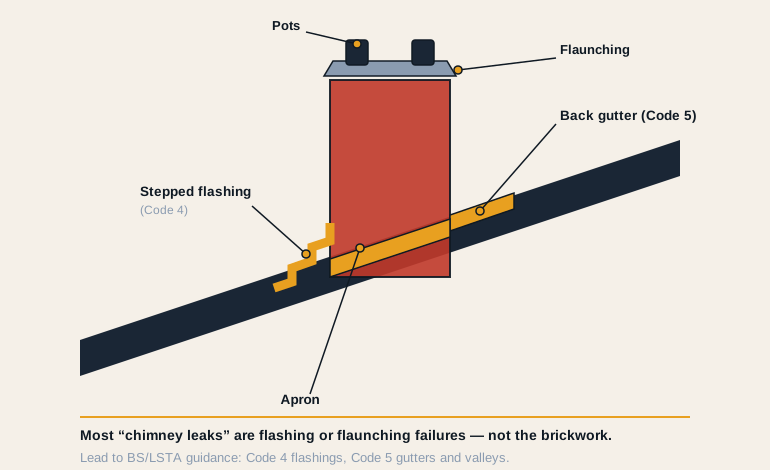
Step and cover flashing replacement at chimney abutments. Code 4 soakers with Code 5 cover flashing as standard specification.
Lead fails from fatigue and thermal movement, not from wear. Oversized sheets, wrong-code lead and unsupported laps are the three things that cause it — all of them installation faults rather than material faults. Across Newton Aycliffe the pattern is fairly consistent: post-war new-town housing, predominantly concrete interlocking tile.
A split or crack running across a flashing or valley
Lead lifted out of the brickwork joint at a chimney or abutment
White powdery deposits on the lead surface
Staining on the wall or ceiling directly below a lead detail
Lead that ripples or buckles noticeably in summer heat
When it is not the answer: Lead does not need replacing simply because it looks old. Properly sized and fixed lead lasts well over a century — a patina is not a defect and anyone quoting on appearance alone is quoting for nothing.
Chimney lead detail: apron, stepped flashing and back gutter are where stack leaks begin.
Lead Roofing in Newton Aycliffe
Why Does Local Roofing Knowledge Matter?
Newton Aycliffe's housing stock is predominantly All post-war new town stock — 1950s through 1980s bungalows and semis with concrete interlocking tiles, many with flat-roofed extensions. Understanding the specific roof types and their failure modes is what separates a knowledgeable local roofer from a national firm that sends whoever's nearest.
Local Climate & Roofing Conditions
Exposed position on the Durham plain with westerly weather; damp winters accelerate nail corrosion on original steel fixings. This directly affects how quickly specific roofing problems develop and which repair approaches last longest in local conditions.
Common Lead Roofing Issues in Newton Aycliffe
Widespread nail sickness on 50–60 year old original fixings; flat roof failure on bungalow extensions; blocked valleys on properties with tree cover. We attend these jobs regularly across Newton Aycliffe and carry the most common materials on the vehicle to avoid return visits.
Darlington Roofing Experts
Covering: Newton Aycliffe & surrounding area
Call: 01325 787169
Response: 5 miles from Darlington base — typically under 60 minutes for emergencies
Hours: Mon–Fri 7:30am–6pm · Sat 8am–2pm
Emergency: 24/7
Why Choose Us
NFRC Registered
Industry-recognised quality and safety standards.
10-Year Guarantee
Written workmanship guarantee on all work.
No Hidden Costs
Fixed quote before we start. No surprises.
Free Survey
We get on the roof before quoting. Always.
The process
The Newton Aycliffe Job, Start to Finish
1. Survey the detail
We establish why it failed — sheet size, code, fixing or substrate — because replacing like for like repeats the fault. Around Newton Aycliffe this step is where most of the surprises get found rather than later.
2. Specification
Correct lead code for the application and sheet sizes within Lead Sheet Association limits, with expansion allowance designed in.
3. Access
Scaffold or tower depending on the detail, with the roof planes below protected.
4. Strip and prepare
Old lead removed, substrate checked and repaired, and the joint or chase raked out ready.
5. Dress and fix
Lead hand-dressed on site, fixed with lead wedges and clips, laps and welts formed to allow movement.
6. Patination and sign-off
Patination oil applied to prevent staining runoff onto brickwork, then photographs and written guarantee. Everything is cleared before we leave a Newton Aycliffe property — including the pavement where scaffold has stood.
The one thing we do differently in Newton Aycliffe: we photograph the roof void as well as the covering, because post-war new-town housing, predominantly concrete interlocking tile hides most of its problems inside.
Timescales
Realistic Timings for Newton Aycliffe Properties
Job
Typical duration
Single flashing repair
2–4 hours
Chimney flashing renewal
1–2 days
Valley re-lining
2–3 days
Bay roof or porch lead
2–3 days
Parapet gutter re-lining
3–5 days
Lead can be dressed in cold weather but patination oil needs a dry surface to work. We finish leadwork on a dry day or return to apply it.
Add a day to most of these in Newton Aycliffe where scaffold has to be licensed through Durham County Council.
Access
Scaffold, Skips & Street Access
Lead details are usually reached from tower or scaffold depending on height and duration. Scaffold is specified for: chimney flashings, valley re-lining, parapet gutters and any lead detail above single storey - always itemised in your written quote, never a hidden extra, and we arrange it.
Newton Aycliffe was planned with generous access and parking, so scaffold and skips sit on the plot in nearly every case — among the cheapest access in the area. Pavement scaffold and skip permits go through Durham County Council; allow a few working days on streets like Beveridge Way, Burn Lane where space is tight.
Pricing
Lead Roofing Prices in Newton Aycliffe
Job
Typical range
Notes
Single flashing repair
£180–£400
Where the surrounding lead is sound
Chimney flashing renewal
£350–£700
Apron, step and cover flashings
Valley re-lining
£400–£1,200
Per valley, Code 4 or 5
Bay or porch roof in lead
£900–£2,200
Hand-dressed, patination treated
Parapet gutter re-lining
£1,200–£3,000
Period and commercial stock
Lead soakers to an abutment
£250–£600
Per elevation
What moves the price
Lead code required for the application — heavier code costs more per square metre
Area and the number of separate sheets, since sizing limits are non-negotiable
Substrate condition beneath the old lead, which is unknown until it is lifted
Access and scaffold, particularly for parapet and valley work
Whether the detail is being redesigned because the original was wrongly sized
Worked example: A split valley on a Victorian villa in Yarm — old lead stripped, substrate boarded, Code 5 lead re-laid in correctly sized sheets with welted laps and patination oil applied — £1,340 including scaffold.
No deposit on repairs under £500. Larger leadwork is staged with nothing payable before materials are on site. Lead code and sheet sizing are stated on the quote.
Figures are for typical Newton Aycliffe stock — post-war new-town housing, predominantly concrete interlocking tile — and are confirmed in writing after survey.
Guarantee
What the 10-Year Guarantee Actually Covers
Workmanship guaranteed for 10 years. Correctly specified lead itself has a service life measured in generations, which is why sheet sizing and fixing method are stated in the quote.
Covered: workmanship for 10 years, in writing, transferable if you sell.
On top: manufacturer warranties on materials (terms vary by product).
Not covered: storm or impact damage - that is an insurance matter, and we will document it for your claim.
If a fault appears in covered work, we come back and put it right. No quibbling, no re-charge.
On Newton Aycliffe properties we note the covering type and fixing specification on the guarantee document itself, which matters on post-war new-town housing, predominantly concrete interlocking tile.
Good to know
Disruption, Mess & Weather
Quiet, clean work by roofing standards. Some hammering while lead is dressed, and a scaffold if the detail is high up. You do not need to stay home for external work - we just need power and access agreed in advance. On Newton Aycliffe streets we let the immediate neighbours know before scaffold arrives.
Leadwork runs year-round — it is one of the few roofing trades genuinely unaffected by cold, though wet surfaces delay patination. Flat, open new-town layout with little wind shelter; ridge and verge lift is the recurring storm damage.
Customer Reviews
What Newton Aycliffe Customers Say
★★★★★
“Nail sickness across the back slope of our bungalow. Diagnosed honestly — told us repair was viable rather than pushing for a re-roof. Saved us thousands.”
Dave S. · Sunnydale, Newton Aycliffe
★★★★★
“Flat roof on our rear extension had been patched twice before. New GRP system fitted — wish we'd done it years ago.”
Lynn F. · Stephenson Way, Newton Aycliffe
★★★★★
“Emergency call-out after storm damage. On site within the hour. Made safe that evening and permanently repaired the following morning.”
Chris W. · School Aycliffe, Newton Aycliffe
Covering DL5 and surrounding postcodes.
Free Quote — Newton Aycliffe
Lead flashing from £350. Valley replacement from £600. Free quotes. No call-out fee.
Realistic 2025 prices for Newton Aycliffe properties. All quotes are free, written and itemised before work begins.
Job Type
Typical Cost
Lead flashing — chimney abutment
£350–£700
Lead valley replacement (per m)
£200–£350/m
Bay window lead flat roof
£400–£800
Dormer lead work
£500–£1,200
Lead soakers (per 10)
£150–£300
Lead re-dressing and resealing
£150–£400
All prices are installed costs. Call 01325 787169 for a free written quote.
The Most Common Lead Work on Newton Aycliffe Properties
Lead roofing on Newton Aycliffe properties takes several forms depending on the era and type of construction. Predominantly post-war new town development from the 1940s–60s, with predominantly concrete interlocking tile roofs on semi-detached and terraced housing across the town. Chimney flashings are the most frequent repair call — step and cover flashings at chimney abutments that have either been incorrectly installed, installed in underspec material, or simply reached the end of a 40–60 year lifespan. Valley gutters on pitched roofs and flat lead sections over bay windows and porches are the other common lead work items we attend in Newton Aycliffe.
Why Lead Fails in Newton Aycliffe's Climate
Lead failure in Newton Aycliffe is almost always caused by inadequate allowance for thermal movement rather than material failure. Exposed plateau position with limited natural shelter creates significant wind exposure — mortar ridge bedding and nail fixings deteriorate faster here than in valley towns. A 3m lead valley sheet can move 15–20mm between midwinter and midsummer. If the sheet is fixed at multiple points and cannot move freely, it splits at the fixings over time. We form all lead bays to Lead Sheet Association specification — maximum 1.5m for Code 4, 2.25m for Code 5 — with correct clips rather than through-fixings.
Lead Specification for Newton Aycliffe Properties
The correct lead specification for Newton Aycliffe varies by application. Code 4 lead (1.8mm) for chimney soakers and stepped flashings; Code 5 (2.24mm) for cover flashings and valley gutters; Code 6 (2.65mm) for larger flat roof sections and parapet gutters. Using Code 3 lead — which some contractors use to reduce material costs — on applications that require Code 4 or 5 produces a product that fails significantly earlier than correctly specified lead. All our lead work in Newton Aycliffe is specified to BS EN 12588 and installed to Lead Sheet Association guidelines.
Code 4 lead (1.8mm) for soakers and stepped flashings, Code 5 lead (2.24mm) for cover flashings and any larger flat areas. These are the correct specifications per the Lead Sheet Association guidelines. Thinner lead is sometimes used to reduce costs — it fails earlier and costs more over the life of the roof.
Lead correctly installed to BS 6915 specification lasts 60–100 years. The failures we see are almost always installation errors — lead fixed too rigidly without allowance for thermal movement, or joins not properly lapped. Done correctly, lead is the longest-lasting roofing material available.
Often yes. If the lead sheet itself is in sound condition but has lifted at the joints or pulled away from the wall, re-dressing and resealing is significantly cheaper than full replacement. If the lead has cracked, split under thermal stress or been installed in underspec material, replacement is necessary.
Yes. We're registered with the National Federation of Roofing Contractors, which means we meet recognised industry standards for quality, safety and workmanship. All our work comes with a written 10-year workmanship guarantee.
Yes. All quotes are free, no-obligation and provided in writing. We get on the roof to measure and inspect before quoting — we don't estimate from the street. There's no call-out charge for the survey visit.
We cover Darlington and approximately a 20-mile radius including Stockton-on-Tees, Middlesbrough, Newton Aycliffe, Bishop Auckland, Northallerton, Shildon, Spennymoor, Hurworth, Heighington, Ferryhill, Sedgefield and all surrounding villages.
Yes. We carry £5m public liability insurance on all work. We're happy to provide evidence of insurance cover before starting any job. Never use a roofing contractor who can't provide proof of insurance.