⭐ 4.9/5 · 127 Google Reviews · Repointing, Lead & Stack Repairs
Chimney Repairs in Long Newton
Chimney stacks are the most maintenance-intensive part of any pitched roof. We repoint, reflash and rebuild stacks across the full coverage area. Covering Long Newton, Eaglescliffe and the surrounding area.
Tell us the job in 30 seconds. No pushy sales, no call-out fee. See how we work.
20+
Years Local
127
5★ Reviews
24/7
Emergency
10yr
Guarantee
Chimney Repairs in Long Newton typically costs £150–£350 for repointing, small single-flue stack, rising to £150–£350 for flaunching recast and pots reset. Free survey and a written itemised quote first. Call 01325 787169.
✓ NFRC Registered
✓ Fully Insured
✓ 10 Year Guarantee
✓ Free Quotes
✓ No Call-Out Fee
✓ 14 miles Away
Chimney Repairs in Long Newton
Chimney Repairs — Long Newton
Chimney stacks are the most maintenance-intensive part of any pitched roof. We repoint, reflash and rebuild stacks across the full coverage area. Chimney repointing from £250. Lead flashing from £350.
Chimney Repointing
Raking out and repointing deteriorated mortar joints. Lime or cement mortar matched to the property age and type.
A chimney is the most exposed masonry on the building. Before anyone quotes, establish whether the mortar has failed, the brick faces have failed, or the flashing at roof level has failed — they are three different jobs at three very different prices. What we see on Long Newton roofs reflects the local stock — village stone and brick cottages with modern infill.
Damp staining on the chimney breast inside, often at first-floor level
Mortar debris on the roof or in the gutter below the stack
Visible gaps in the joints, or brick faces crumbling
A pot leaning, or flaunching cracked and lifting
Lead flashing lifted, split or pulled out of the brickwork
When it is not the answer: A damp chimney breast is very often a failed lead flashing rather than the stack itself. Repointing a sound stack while leaving split lead in place solves nothing and wastes the scaffold. Read the full guide.
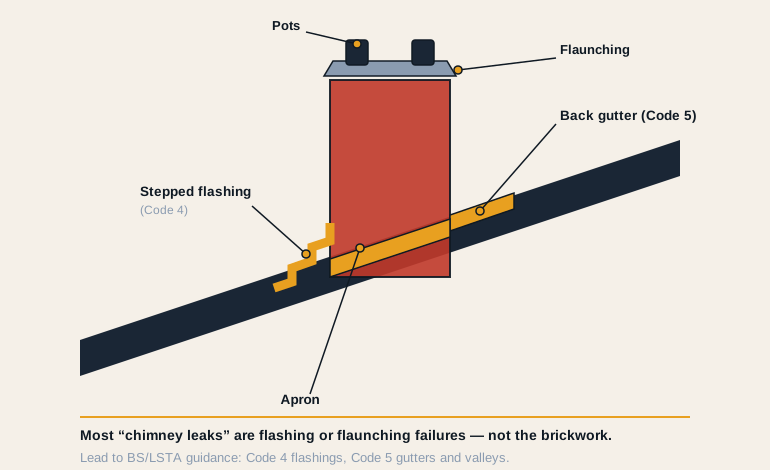
Chimney lead detail: apron, stepped flashing and back gutter are where stack leaks begin.
Chimney Repairs in Long Newton
Why Does Local Roofing Knowledge Matter?
Long Newton is a historic village with a traditional core of stone and brick properties dating from the 17th to 19th century, alongside post-war and modern residential development on the village fringe. Understanding the specific roof types and their failure patterns is what separates a roofer who gets it right first time from one who guesses.
Climate & Roofing in Long Newton
Open agricultural setting between the Tees Valley and the coast — multi-directional wind exposure with no significant natural shelter. West-facing and south-west-facing pitches see mortar deterioration faster than sheltered town-centre properties. This directly affects maintenance frequency and which repair approaches last longest.
Common Chimney Repairs Issues in Long Newton
Mortar ridge failure on exposed pitches; lead flashing deterioration on the older stone properties in the village core; nail sickness on post-war fringe housing. We cover Long Newton regularly from our Darlington base and carry the most common materials on the vehicle.
Darlington Roofing ExpertsCovering: Long Newton & Eaglescliffe
Call: 01325 787169
Response: 14 miles from Darlington — typically 20 minutes
Hours: Mon–Fri 7:30am–6pm · Sat 8am–2pm Emergency: 24/7
The process
Step by Step: Chimney Repairs in Long Newton
1. Survey from the stack
Scaffold or drone assessment of every face, the flaunching, the pots and the flashings — a chimney cannot be judged from the pavement. On Long Newton stock we allow extra time at this stage.
2. Diagnosis and quote
Mortar, brick, flaunching and flashing each assessed separately and priced separately so you can see what is driving the cost.
3. Party wall check
On terraced stacks we establish ownership and, where a rebuild is involved, flag whether the Party Wall etc. Act 1996 is engaged.
4. Scaffold
Full stack access with a working platform at the right height — chimney work cannot be done properly from a ladder.
5. The work
Repointing in a matched mix, flaunching recast, pots reset or replaced, cowls fitted, lead re-dressed or renewed as specified.
6. Cleanup and sign-off
Roof planes cleared of mortar debris, gutters flushed, completion photographs from the stack and written guarantee. We leave a Long Newton site as we found it, drive swept and gutters flushed.
On Long Newton properties the survey stage matters more than usual: Village stone and brick cottages with modern infill means what we find in the roof void frequently changes the recommendation.
Timescales
How Long Does It Take?
Job
Typical duration
Flaunching recast and pots reset
1 day
Cowl or bird guard fitting
2–3 hours
Full stack repointing
2–3 days
Lead flashing renewal
1–2 days
Rebuild above roof line
3–5 days
Mortar will not cure in frost. We do not repoint or bed in freezing conditions — work carried out in a hard frost fails within a season, and that is a promise we would rather not have to honour.
On Long Newton properties allow a little more where the covering is original: village stone and brick cottages with modern infill rarely comes apart to schedule.
Access
Scaffold, Skips & Street Access
Chimney work needs a scaffold platform at stack height, every time. Scaffold is specified for: all stack work without exception; a tower may suffice on a bungalow or single-storey extension stack - always itemised in your written quote, never a hidden extra, and we arrange it.
Long Newton is a small linear village with wide verges; access is easy but the main road frontage needs traffic-aware scaffold planning. Pavement scaffold and skip permits go through Stockton-on-Tees Borough Council; allow a few working days on streets like Darlington Road, Elton Lane where space is tight.
Pricing
Chimney Repairs Costs Across Long Newton
Job
Typical range
Notes
Repointing, small single-flue stack
£150–£350
Scaffold included
Repointing, two to four pot stack
£350–£800
Mortar matched to brickwork
Flaunching recast and pots reset
£150–£350
Often the actual leak source
Cowl or bird guard fitted
£80–£200
Per pot
Lead flashing renewal to stack
£350–£700
Code 4 or 5, hand-dressed
Rebuild above roof line
£900–£2,500
Matching brick, party wall notice may apply
What moves the price
Stack size and number of flues — a four-pot stack is a different job to a single flue
Access and scaffold, which is often the largest single line on a chimney quote
Mortar specification: lime mixes on soft Victorian brick cost more in labour
Whether the brick faces have spalled, which turns pointing into rebuilding
Party wall coordination on terraced stacks shared with a neighbour
Worked example: A shared two-pot stack on a terrace at North Road — fully repointed in a lime mix, flaunching recast, both pots reset and a new lead apron dressed — £1,480 including scaffold across both properties, split between the two owners.
Staged on stack rebuilds, with nothing payable before materials and scaffold are on site. Where a stack is shared we quote the whole stack and invoice each owner separately for their share.
Prices reflect Long Newton conditions, including permit costs where Stockton-on-Tees Borough Council requires a licence.
Guarantee
Guarantee Terms for Long Newton Customers
Workmanship guaranteed for 10 years, including the pointing and the leadwork. Note that we specify the mortar mix to suit your brickwork, and that specification is part of what the guarantee stands behind.
Covered: workmanship for 10 years, in writing, transferable if you sell.
On top: manufacturer warranties on materials (terms vary by product).
Not covered: storm or impact damage - that is an insurance matter, and we will document it for your claim.
If a fault appears in covered work, we come back and put it right. No quibbling, no re-charge.
For Long Newton customers we register any manufacturer warranties on your behalf and send the documentation through with the guarantee.
Good to know
Disruption, Mess & Weather
Scaffold for several days and mortar debris on the roof below the stack, which we clear as part of the job. Fireplaces in use should be left unlit while pots are off. You do not need to stay home for external work - we just need power and access agreed in advance. For Long Newton properties we confirm parking arrangements with you in advance.
Stack work is frost-sensitive. Between December and February we watch the forecast and will move a booking rather than bed mortar that is going to freeze. Flat, open agricultural land with unimpeded westerly wind exposure.
Covering TS21 and surrounding postcodes.
Free Quote — Long Newton
Chimney repointing from £250. Lead flashing from £350. No call-out fee.
“Old stone cottage on the village green — Welsh slate repair done correctly with matching material. No shortcuts.”
Elizabeth H. · Long Newton village
★★★★★
“Flat roof on the extension had been leaking since we bought the house. EPDM replacement sorted it completely.”
Tom R. · Long Newton, nr Eaglescliffe
★★★★★
“Lead flashing failure on a period property. Correctly specified Code 5 lead used throughout.”
Frances D. · Long Newton
How We Inspect Chimneys in Long Newton
All chimney work in Long Newton starts with a scaffold-accessed inspection of the full stack — not a ground-level look with binoculars. From scaffold we inspect mortar joints, flaunching condition, lead flashing at all abutments, pot and terminal condition, and any visible cracking in the brickwork. Mortar ridge failure on exposed pitches, lead flashing deterioration on older stone properties in the village core, nail sickness on post-war fringe housing. An accurate diagnosis from scaffold level means the work quoted is the work that's actually needed rather than a conservative estimate covering unknowns we haven't looked at.
Repointing vs Rebuilding in Long Newton
The decision between repointing and rebuilding a chimney stack in Long Newton depends on the structural integrity of the brickwork. Repointing is appropriate when the bricks are sound and only the mortar joints have eroded. Rebuilding is required where frost action has spalled the brick faces, where settlement or movement has cracked the stack, or where the mortar has eroded so deeply that the bricks themselves have shifted position. Historic village with a traditional core of stone and brick properties dating from the 17th to 19th century in Long Newton — the older the stack the more likely rebuilding is appropriate on the upper section even if the lower section is sound.
Lead Flashings in Long Newton's Climate
Lead at chimney abutments in Long Newton faces the specific stress of open agricultural setting between the Tees Valley and the coast — multi-directional wind exposure with no significant natural shelter, accelerating mortar deterioration. Correctly installed lead with proper clips and expansion allowance handles this movement without cracking. The failures we see on Long Newton properties are almost always installation defects — lead fixed too rigidly, or installed in Code 3 when Code 4 or 5 is required. We use Code 4 for soakers and step flashings, Code 5 for cover flashings, and form all bays to BS 6915 lengths to accommodate thermal movement.
Yes. Any contractor offering to repoint a chimney from a ladder is working unsafely and without adequate insurance. Scaffold is included in our chimney repair quotes.
It depends on the age and type of the stack. Victorian and older stone properties should be repointed with lime mortar matching the original — using hard cement mortar on older brickwork causes the bricks to crack rather than the mortar joint. We match the specification to the stack.
Yes. An uncapped unused chimney lets rain in directly, saturating the internal brickwork and causing damp patches on interior walls. We fit capping pots that prevent water entry while maintaining ventilation through the flue.
Yes. We're registered with the National Federation of Roofing Contractors, meeting recognised industry standards for quality and safety. All work comes with a written 10-year workmanship guarantee.
Yes. All quotes are free, no-obligation and provided in writing. We get on the roof to measure and inspect before quoting — no estimates from the street, no call-out charge for the survey visit.
We cover Darlington and approximately a 20-mile radius including Stockton-on-Tees, Middlesbrough, Newton Aycliffe, Bishop Auckland, Northallerton, Yarm, Eaglescliffe, Barnard Castle, Richmond and all surrounding villages.
Yes. We carry £5m public liability insurance on all work and are happy to provide evidence of cover before starting any job.