⭐ 4.9/5 · 127 Google Reviews · Serving Eaglescliffe
Roofers in Eaglescliffe
Eaglescliffe is a substantial residential suburb adjacent to Yarm, predominantly 1930s–60s housing with high owner-occupancy. Strong roofing market with well-maintained properties. Free quotes, no call-out fee.
Tell us the job in 30 seconds. No pushy sales, no call-out fee. See how we work.
20+
Years Local
127
5★ Reviews
24/7
Emergency
10yr
Guarantee
We cover Eaglescliffe for roof repairs, replacements, flat roofing, guttering and 24/7 emergency call-outs, working across TS16. Repairs start at £150 and every job carries a written 10-year guarantee. Call 01325 787169 for a free survey.
✓ NFRC Registered
✓ Fully Insured
✓ 10 Year Guarantee
✓ Free Quotes
✓ No Call-Out Fee
✓ 13 miles Away
Honest advice
Is Roofing in Eaglescliffe the Right Fix?
Most roofs that worry a homeowner do not need replacing. Knowing which of the four common failures you are looking at tells you whether this is a two-hour job or a two-week one.
A damp patch on an upstairs ceiling that darkens after rain
Tiles or slates out of line, or one in the garden after wind
Mortar debris from the ridge or verge in the gutter
Gutters overflowing down the wall face during heavy rain
Daylight visible through the roof from inside the loft
When it is not the answer: A single slipped tile is not a reason to re-roof. Equally, patching a covering whose fixings have gone across every plane is money spent on a roof that is already finished. Read the full guide.
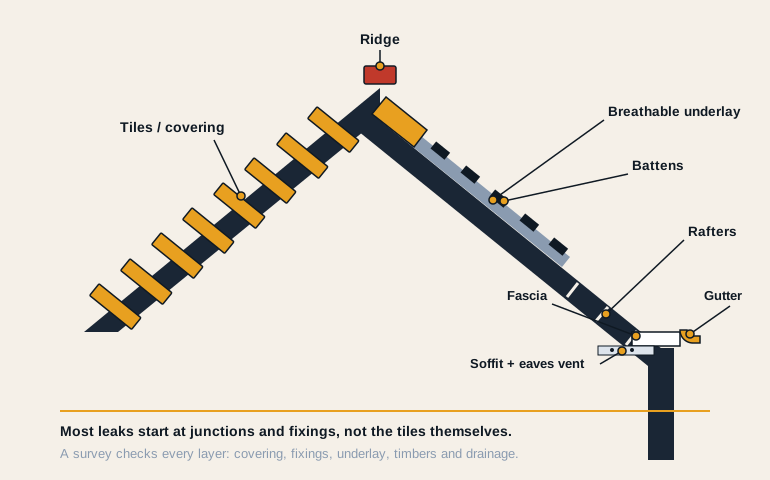
Pitched roof cross-section: every layer a survey checks, from covering down to drainage.
Roofing in Eaglescliffe
Roofers Who Know Eaglescliffe
Eaglescliffe's housing stock is predominantly 1930s and 1950s semi-detached and detached properties with concrete interlocking tile; post-war estates on the fringes; more modern housing toward Ingleby Barwick..
Local Climate & Conditions
South bank of the Tees provides some shelter but above-average humidity for an inland location. Freeze-thaw in winter affects mortar bedding on exposed pitches..
Common Roofing Problems
Nail sickness on 1950s–60s concrete tile roofs; mortar ridge failure on exposed pitches; flat roof deterioration on rear extensions; gutter failure on 1930s properties with undersized uPVC..
Response TimeWe cover Eaglescliffe from our Darlington base. 13 miles — emergency response within 2 hours. Call 01325 787169 any time.
The process
What to Expect: Roofing in Eaglescliffe in Eaglescliffe
1. Free survey
We get onto the roof or fly it, find the actual cause rather than the symptom, and photograph what we find.
2. Written itemised quote
A fixed price with the work described component by component, so you can compare it against anyone else’s.
3. Scheduling
Most work is booked within one to two weeks. Active leaks are made safe the same day.
4. Access day
Scaffold, tower or ladder as the job requires, with planting, paving and drives protected before anything starts.
5. The work
Carried out to BS 5534 fixing standards, with anything unexpected reported and priced before it is done rather than after.
6. Cleanup and sign-off
Site cleared, gutters flushed, completion photographs sent through and the written guarantee issued.
Timescales
Job Durations at a Glance
Job
Typical duration
Slipped or cracked tile refix
1–2 hours
Leak trace and repair
Half a day
Ridge line re-bedding
1 day
Guttering replacement
1 day
Full re-roof, three-bed semi
5–8 days
Tiling, mortar and flat-roof work all pause in driving rain or high wind. We build weather margin into every booking rather than rushing a job that then fails.
Access
Scaffold, Skips & Street Access
Smaller repairs run from a roof ladder or tower, which keeps the cost down. Scaffold is specified for: all full re-roofs, chimney work, roofline replacement and anything needing more than a day of standing time at height - always itemised in your written quote, never a hidden extra, and we arrange it.
Eaglescliffe is largely interwar and post-war housing with driveways, so access is straightforward and scaffold costs sit at the lower end. Pavement scaffold and skip permits go through Stockton-on-Tees Borough Council; allow a few working days on streets like Yarm Road, Urlay Nook Road where space is tight.
Pricing
What Roofing in Eaglescliffe Costs in Eaglescliffe
Job
Typical range
Notes
Slipped or cracked tile refix
£150–£250
Per visit including access
Leak trace and repair
£180–£450
Includes water testing where needed
Ridge line re-bedding
£400–£900
Or dry-fix at similar cost
Guttering replacement, semi
£400–£800
New brackets and correct falls
Full roofline, semi-detached
£1,500–£4,000
Fascias, soffits and guttering
Full re-roof, three-bed semi
£5,500–£9,000
Including scaffold and waste
What moves the price
Access, and whether scaffold is needed rather than a ladder or tower
Roof pitch, height and the number of hips, valleys and dormers
Covering type — concrete tile, clay or natural slate differ substantially
Timber and underlay condition, only knowable once a covering is lifted
Whether the work is one component or a run of failures across a plane
Worked example: A three-bed semi with a slipped ridge and two cracked tiles: ridge re-bedded over four metres, tiles matched and refixed, gutters flushed — £640 including tower access and waste removal.
No deposit on repairs under £500. Larger jobs are staged with nothing payable before materials are on site. All quotes are written and itemised, with scaffold and waste shown as separate lines.
Guarantee
Your Guarantee, Explained
Every job carries a written 10-year workmanship guarantee, transferable if you sell, with manufacturer warranties on materials on top.
Covered: workmanship for 10 years, in writing, transferable if you sell.
On top: manufacturer warranties on materials (terms vary by product).
Not covered: storm or impact damage - that is an insurance matter, and we will document it for your claim.
If a fault appears in covered work, we come back and put it right. No quibbling, no re-charge.
Good to know
Disruption, Mess & Weather
Small repairs are a few hours of ladder work. Larger jobs mean scaffold and real noise — we agree working hours in advance and sheet everything below. You do not need to stay home for external work - we just need power and access agreed in advance.
We work year-round and never leave a covering open overnight — temporary weatherproofing goes on the same day if rain stops play. Tees valley damp with morning fog off the river on still autumn mornings.
Free Quote — Eaglescliffe
No call-out fee. No obligation. Written quote before we start.
“Full re-roof on our 1930s semi. Dry-fix ridge fitted as standard — the mortar bedding had been failing every few years. Final job done properly.”
Robert H. · Glebe Road, Eaglescliffe
★★★★★
“Nail sickness on the rear slope — section re-nailed with stainless fixings. No pressure toward a full re-roof we didn't need.”
Susan T. · Thornaby Road, Eaglescliffe
★★★★★
“Fascia and guttering replacement on our 1950s detached. Finished neatly, matched properly.”
David K. · Preston Road, Eaglescliffe
The Housing Stock in Eaglescliffe
Eaglescliffe's housing is predominantly Predominantly 1930s and 1950s semi-detached and detached properties with concrete interlocking tile, post-war estates on the fringes, modern housing toward Ingleby Barwick. Each era has its own roofing characteristics, failure patterns, and maintenance requirements. Knowing which type you have is the starting point for correct diagnosis and appropriate repair specification.
Climate and Roofing in Eaglescliffe
South bank of the Tees with above-average humidity for an inland location — freeze-thaw in winter affects mortar bedding on exposed pitches more than in sheltered urban positions. This affects maintenance frequency, the priority order for repair work, and the specification of replacement materials.
Getting a Free Quote in Eaglescliffe
All quotes in Eaglescliffe are free, written and itemised. We get on the roof before quoting — no estimates from the pavement, no call-out charge for the survey visit. Call 01325 787169 to book.
1930s–50s Roofing in Eaglescliffe — What to Expect
The dominant housing stock in Eaglescliffe is 1930s and 1950s semi-detached and detached. Properties from this period are now 70–90 years old — the age range where systematic maintenance is essential to avoid larger capital expenditure. Mortar ridge bedding on 1930s Eaglescliffe properties is typically at or past the point where replacement with dry-fix makes more long-term sense than repeated repointing. Nail sickness on 1950s stock is widespread — the same corrosion pattern affecting similar-era housing across the Tees Valley.
Flat Roofs on Eaglescliffe Rear Extensions
Eaglescliffe has a high density of rear extensions — many added in the 1970s and 1980s to original 1930s and 1950s properties. Original felt flat roofs on these extensions are now 40–50 years old. Where felt systems are reaching end of life across Eaglescliffe, we replace with GRP fibreglass or EPDM rubber, both of which offer 25–50 year lifespans compared to the 10–15 year lifespan of a new felt system.
Free Surveys in Eaglescliffe
Eaglescliffe is 13 miles from Darlington — typically 20 minutes. Free no-obligation surveys and written quotes. Call 01325 787169.
Our Commitment to Darlington and County Durham
We are a Darlington-based roofing contractor covering County Durham and North Yorkshire. Every job we take on across the area is handled by our own team — not passed to a subcontractor we have no control over. We know the specific housing stock, the common failure patterns, and the correct material specifications for properties across the region. This local knowledge directly affects the quality of diagnosis and the durability of the work we carry out.
Free Quotes — What to Expect
Every quote we provide is free and comes with no obligation to proceed. We get on the roof before quoting — measuring the area, inspecting the structure, and confirming the correct materials. The written quote you receive is a fixed price for the specific work described, not an estimate subject to revision once we start. We don't quote for the easy parts and add the rest later.
Registered with the National Federation of Roofing Contractors. £5m public liability insurance on all work — evidence available on request. Written 10-year workmanship guarantee on all replacement and major repair work. Call 01325 787169 for your free, no-obligation quote.
Covering TS16 and surrounding postcodes.
Services here
Roofing Services in Eaglescliffe
Chimney Repairs Eaglescliffe
A chimney is the most exposed masonry on the building. Before anyone quotes, establish whether the mortar has failed, the brick faces have failed, or…
Nail sickness on 1950s and 1960s concrete tile roofs is widespread — original steel fixings are now 60–70 years old and corroding. Mortar ridge failure on exposed pitches of 1930s semis is also common.
13 miles from Darlington — typically 20 minutes. Available 24/7.
Yes, particularly on exposed pitches. Mortar bedding typically lasts 15–20 years before repointing is needed. Dry-fix is mechanically secured, lasts the life of the roof with no maintenance.
Yes. Free no-obligation surveys across Eaglescliffe and Yarm.
A standard 1930s semi takes 3–4 days for a full re-roof including scaffold. Most jobs are completed within a week.
In most cases yes. Common 1930s profiles are still available in matching or near-matching versions. We confirm the match before starting.
Most of Eaglescliffe's residential areas are not conservation areas — standard permitted development rules apply. We'll confirm if any restrictions apply at survey.