Professional soft-wash moss and lichen removal. No pressure washing — we protect your tiles while eliminating the growth. Covering Yarm, Eaglescliffe, Kirklevington, Ingleby Barwick and the surrounding area.
Tell us the job in 30 seconds. No pushy sales, no call-out fee. See how we work.
20+
Years Local
127
5★ Reviews
24/7
Emergency
10yr
Guarantee
Roof Cleaning in Yarm typically costs £250–£450 for single plane clean and treat, rising to £600–£1,200 for full roof clean, detached. Free survey and a written itemised quote first. Call 01325 787169.
✓ NFRC Registered
✓ Fully Insured
✓ 10 Year Guarantee
✓ Free Quotes
✓ No Call-Out Fee
✓ 14 miles Away
Roof Cleaning in Yarm
Roof Cleaning — Yarm
Professional soft-wash moss and lichen removal. No pressure washing — we protect your tiles while eliminating the growth. Roof cleaning from £300 depending on size. Free surveys.
Soft-Wash Biocide Treatment
Low-pressure application of a proprietary moss-killing solution. Kills moss, lichen and algae at the root without tile damage.
Roof cleaning covers everything growing on the covering — moss, algae, lichen and general soiling. Worth doing when growth is holding water or blocking drainage; not worth doing purely because a neighbour has had theirs done. What we see on Yarm roofs reflects the local stock — Georgian High Street properties, Victorian villas and modern executive estates.
Widespread green or black discolouration across the covering
Growth bridging the tile laps rather than sitting on the surface
Debris and organic matter accumulating in valleys
Gutters filling with granules and growth fragments
Persistent damp staining on a shaded elevation
When it is not the answer: A roof with sound tiles and light surface algae does not need cleaning to function. If the honest reason is kerb appeal, that is a legitimate choice — but it should be a choice, not a scare. Read the full guide.
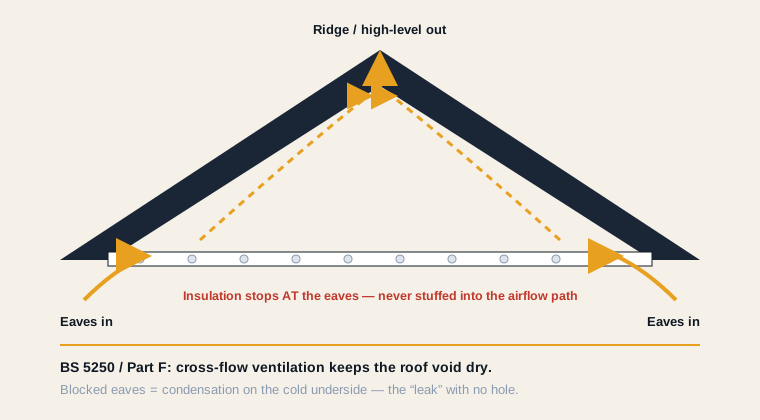
Roof void airflow: insulation must stop at the eaves or the ventilation path closes.
Roof Cleaning in Yarm
Why Does Local Roofing Knowledge Matter?
Yarm's housing stock is predominantly Georgian townhouses on the High Street and adjacent streets with clay plain tile and Welsh slate; Victorian semis on the residential fringe; modern detached on the outskirts toward Eaglescliffe. Knowing the specific roof types and their failure patterns is what separates a knowledgeable local roofer from a national firm that sends whoever's nearest.
Climate & Roofing in Yarm
River Tees on three sides creates higher humidity than inland towns, accelerating moss growth and mortar decay. Conservation area status applies to much of the town centre, restricting material choices on period properties. This directly affects how quickly specific problems develop and which repair approaches last longest in local conditions.
Common Roof Cleaning Issues in Yarm
Lead flashing failure on Georgian and Victorian town centre properties; moss accumulation from river humidity on north-facing slopes; clay plain tile slippage on older properties; conservation area material constraints. We attend these jobs regularly across Yarm and carry the most common materials on the vehicle.
Darlington Roofing ExpertsCovering: Yarm & surrounding area
Call: 01325 787169
Response: 14 miles from Darlington — typically 20–25 minutes
Hours: Mon–Fri 7:30am–6pm · Sat 8am–2pm Emergency: 24/7
The process
Step by Step: Roof Cleaning in Yarm
1. Assess covering condition first
Cleaning a roof that is already failing simply reveals the failure. We check the covering before quoting the clean. On Yarm stock we allow extra time at this stage.
Growth scraped and brushed off by hand — never pressure washed, which strips the tile surface and accelerates regrowth.
4. Full drainage clearance
Gutters, valleys, hoppers and downpipes cleared and flushed once the covering is clean.
5. Biocide treatment
Dilute roof-safe biocide applied to slow regrowth and kill residual spores.
6. Condition report
Photographs of anything the growth was concealing, with honest advice and no obligation. Everything is cleared before we leave a Yarm property — including the pavement where scaffold has stood.
The one thing we do differently in Yarm: we photograph the roof void as well as the covering, because Georgian High Street properties, Victorian villas and modern executive estates hides most of its problems inside.
Timescales
Typical Timescales in Yarm
Job
Typical duration
Single plane treatment
Half a day
Full roof clean, semi
1 day
Full roof clean, detached
1–2 days
Gutter clearance included
Same visit
Typical interval before repeat
3–5 years
Biocide application needs a dry window to be effective. Scraping can proceed in most conditions short of high wind or ice.
Weather is the main variable in Yarm. Tees loop position brings river fog and damp still air that keeps north-facing roofs green.
Access
Scaffold, Skips & Street Access
Ladder and roof ladder access on almost all domestic properties. Scaffold is specified for: steep or high roofs, fragile coverings, and properties where there is no safe ladder footing at ground level - always itemised in your written quote, never a hidden extra, and we arrange it.
Yarm High Street is a conservation area with cobbled frontages, wynds too narrow for a wagon and heavy footfall — scaffold there is a licensed, carefully programmed job through Stockton-on-Tees Borough Council. Pavement scaffold and skip permits go through Stockton-on-Tees Borough Council; allow a few working days on streets like High Street, Atlas Wynd, Silver Street where space is tight.
Pricing
Real Yarm Prices for Roof Cleaning
Job
Typical range
Notes
Single plane clean and treat
£250–£450
Usually the north elevation
Full roof clean, semi-detached
£500–£800
Including gutter clearance
Full roof clean, detached
£600–£1,200
All planes, valleys and hoppers
Biocide treatment only
£250–£450
Light growth, preventive
Render or wall soft wash
£300–£700
Where growth has spread down
Post-clean minor repairs
£150–£400
Quoted separately if found
What moves the price
Number of planes needing treatment rather than total roof area
Aspect and shading, which determine both growth depth and regrowth speed
Tile porosity — older concrete tiles hold growth far more tenaciously
Whether valleys and parapet gutters need clearing as part of the work
Access and safe roof-ladder placement
Worked example: A detached property in Hurworth with heavy growth on two shaded planes — both scraped by hand, all planes treated with biocide, gutters and two valleys cleared — £890 over a day and a half.
No deposit, invoiced on completion. If cleaning reveals defects we quote those separately — we will not roll unrelated repairs into a cleaning invoice.
All Yarm quotes itemise scaffold and waste separately so you can compare like for like.
Guarantee
What We Stand Behind in Yarm
As a maintenance service this is not a 10-year guaranteed installation. What we stand behind is method and care: no pressure washing, no walked-on damage, and any tile we break gets replaced at our cost.
Covered: workmanship for 10 years, in writing, transferable if you sell.
On top: manufacturer warranties on materials (terms vary by product).
Not covered: storm or impact damage - that is an insurance matter, and we will document it for your claim.
If a fault appears in covered work, we come back and put it right. No quibbling, no re-charge.
On Yarm properties we note the covering type and fixing specification on the guarantee document itself, which matters on Georgian High Street properties, Victorian villas and modern executive estates.
Good to know
Disruption, Mess & Weather
A day of scraping noise and debris coming down. We keep the working area sheeted and clear the ground fully before leaving. You do not need to stay home for external work - we just need power and access agreed in advance. Around Yarm we plan deliveries to avoid the school run where it matters.
Late spring through early autumn is the productive window for treatment in the North East; scraping can be done outside it where the roof needs clearing urgently. Tees loop position brings river fog and damp still air that keeps north-facing roofs green.
Customer Reviews
What Yarm Customers Say
★★★★★
“Georgian terrace on West Street — lead valley and chimney flashing replaced correctly. Conservation requirements met without any issues.”
Victoria S. · West Street, Yarm
★★★★★
“Moss removal and soft-wash treatment on our Victorian semi near the river. The difference is remarkable — and no tile damage.”
Charles W. · High Street, Yarm
★★★★★
“Full re-roof on our riverside property. Matching clay tile sourced and laid properly. Job finished on time and exactly as quoted.”
Margaret F. · Church Wynd, Yarm
Covering TS15 and surrounding postcodes.
Free Quote — Yarm
Roof cleaning from £300 depending on size. Free surveys. No call-out fee.
Realistic 2025 prices for Yarm properties. All quotes are free, written and itemised before work begins.
Job Type
Typical Cost
Soft-wash treatment (2-bed semi)
£300–£500
Soft-wash treatment (3-bed semi)
£400–£650
Soft-wash treatment (detached)
£500–£900
Anti-moss coating (per m²)
£8–£15/m²
Manual moss clearance (add-on)
£100–£250
Gutter clear with clean (add-on)
£80–£150
All prices are installed costs. Call 01325 787169 for a free written quote.
Why Moss Grows Faster on Some Yarm Properties
Moss and lichen growth rate in Yarm is driven by three factors: slope orientation (north-facing slopes get less UV), shade from trees or adjacent buildings, and local humidity. River tees on three sides creates higher humidity than inland towns, accelerating moss growth and mortar decay — conservation area status applies to much of the town centre. Properties in Yarm that face north or sit in the shade of mature trees accumulate moss significantly faster than equivalent south-facing exposed properties. For these properties, a shorter treatment cycle of 2–3 years is more cost-effective than waiting until growth becomes heavy.
Soft-Wash vs Pressure Washing on Yarm Roofs
Pressure washing is not a legitimate roof cleaning technique on any Yarm property. It strips the protective aggregate surface from concrete tiles, forces water under tile laps, and often dislodges loose tiles on roofs with advancing nail sickness — a common condition on Yarm's post-war housing stock. We use soft-wash biocide treatment as standard — applied at lower pressure than a garden hose, it kills growth at the root without mechanical damage. The growth dies and detaches naturally over 4–8 weeks.
Post-Treatment Protection for Yarm Roofs
After soft-wash biocide treatment, an anti-moss inhibitor coating applied to the tile surface significantly extends the period before regrowth establishes. On a standard property in Yarm, treated and then coated, the growth-free period extends from the typical 3–4 years to 5–7 years. For properties in Yarm with persistent heavy growth driven by river tees on three sides creates higher humidity than inland towns, accelerating moss growth and mortar decay — conservation area status applies to much of the town centre, this combined treatment programme is significantly more cost-effective than repeated reactive cleans.
Pressure washing strips the protective surface aggregate from concrete tiles and forces water under tile laps. We use soft-wash biocide treatment — lower pressure than a garden hose — which kills growth at the root without damaging the tile surface.
The biocide kills moss and lichen over 4–8 weeks. The growth turns brown and detaches naturally with rainfall and wind. A follow-up brush clean can be done once the growth is dead if a faster visible result is needed.
Yes, noticeably. Heavy moss is one of the most visible signs of deferred maintenance to buyers and surveyors. Professional cleaning before marketing is a low-cost improvement with clear visual impact.
Yes. We're registered with the National Federation of Roofing Contractors, meeting recognised industry standards for quality and safety. All work comes with a written 10-year workmanship guarantee.
Yes. All quotes are free, no-obligation and provided in writing. We get on the roof to measure and inspect before quoting — no estimates from the street, no call-out charge for the survey visit.
We cover Darlington and approximately a 20-mile radius including Stockton-on-Tees, Middlesbrough, Newton Aycliffe, Bishop Auckland, Northallerton, Yarm, Eaglescliffe, Barnard Castle, Richmond and all surrounding villages.
Yes. We carry £5m public liability insurance on all work and are happy to provide evidence of cover before starting any job.